


Mining Camp and Remote Site Gym Guide (2026)
The Short Answer
A mining camp or remote site gym needs to run safely around a roster starting as early as 4am, so durability and serviceability matter more than in a metro gym, since a broken machine can sit unrepaired for weeks. Freight is a real line item, not an afterthought, and should be itemised up front; container shipping is common for remote sites. Typical camp gyms run 100 to 300 square metres with equipment budgets of $80,000 to $200,000, installed around site access windows.
Why a camp gym is part of your duty of care
On a remote or fly-in fly-out site, a gym is not a perk in the same way it might be at a city office, it is one of the few outlets available to shift workers living on site for weeks at a time, often working through the night, with limited access to the kind of recreation and recovery options they would have at home. A well-run camp gym supports fatigue management, mental health and general wellbeing for a workforce with genuinely limited alternatives, which is part of the reason mining and resources companies treat camp facilities as a serious line item rather than a nice-to-have.
This is general guidance, not a substitute for your own workplace health and safety obligations; confirm what your camp gym needs to meet against your company's WHS policy and any site-specific requirements with your safety team.
Camp gym facilities are also part of how a site competes for workers. In a tight labour market, a camp with a genuinely good gym, not a token room with a treadmill and a rusted bench, is a real point of difference when a worker is choosing between two similar rosters at two similar sites. Facilities and HR teams planning a new camp build or an upgrade to an existing one are increasingly treating the gym brief with the same seriousness as accommodation and catering, rather than leaving it as whatever budget is left over once the harder infrastructure is signed off.
Built for a 4am to midnight roster
Camp gyms do not close. A gym serving rotating shifts is realistically in use from 4am, when the first crew comes off night shift or heads out to an early start, through to close to midnight when the last shift finishes for the day. VERVE has fitted out gyms for exactly this pattern, including a South Australian mining town facility that is packed from 4am with shift workers coming straight off the job. That kind of use, extended hours, high frequency, minimal downtime for maintenance, is what should drive the equipment brief, not a standard commercial gym spec built around a typical 6am to 9pm day.
Freight and site access: the line item everyone forgets
Freight to a remote or regional site is a real cost, not a rounding error, and it should be itemised in your quote from the start rather than discovered after equipment has already been ordered.
| Factor | Why it matters | What to ask your supplier |
|---|---|---|
| Distance and road access | Determines truck vs container vs air freight, and transit time | Ask for freight quoted separately, not bundled into equipment pricing |
| Site access windows | Many remote and mine sites control vehicle access to set days or hours | Confirm install crew and delivery timing against your site's access rules before booking a date |
| Container vs palletised freight | Containers suit larger remote orders and can double as secure on-site storage during install | Ask whether your order ships as a container and what that means for unloading on site |
| Local unloading equipment | Not every site has a forklift or crane on hand | Confirm what's needed to unload before the truck or container arrives |
Sizing a camp gym to your workforce
Camp gym size scales with how many people are realistically training in any given hour, not total camp population, since shifts stagger usage across the day. As a general guide, a camp of up to around 150 to 200 people typically needs 100 to 150 square metres and $80,000 to $120,000 in equipment; a larger camp or a permanent site village of 300 or more typically needs 200 to 300 square metres and $150,000 to $200,000 or more. Bigger sites also benefit from more redundancy, two or three of the same cardio machine rather than one, so a single breakdown does not take a whole equipment category offline until parts arrive.
Durability and serviceability: what to spec differently for remote sites
- Commercial-grade equipment built for continuous high-frequency use, not gear designed for a normal 12-hour metro gym day.
- Simple, robust mechanisms over equipment with complex electronics or proprietary parts that cannot be serviced or replaced quickly on site.
- Dust, humidity and temperature-tolerant finishes where the site environment calls for it; confirm with your supplier what's rated for your conditions.
- Flooring that handles heavy equipment, dust and easy cleaning without needing specialist maintenance.
- A basic spare parts kit (belts, cables, common wear items) held on site so a breakdown does not mean a multi-week wait for a freight-in part.
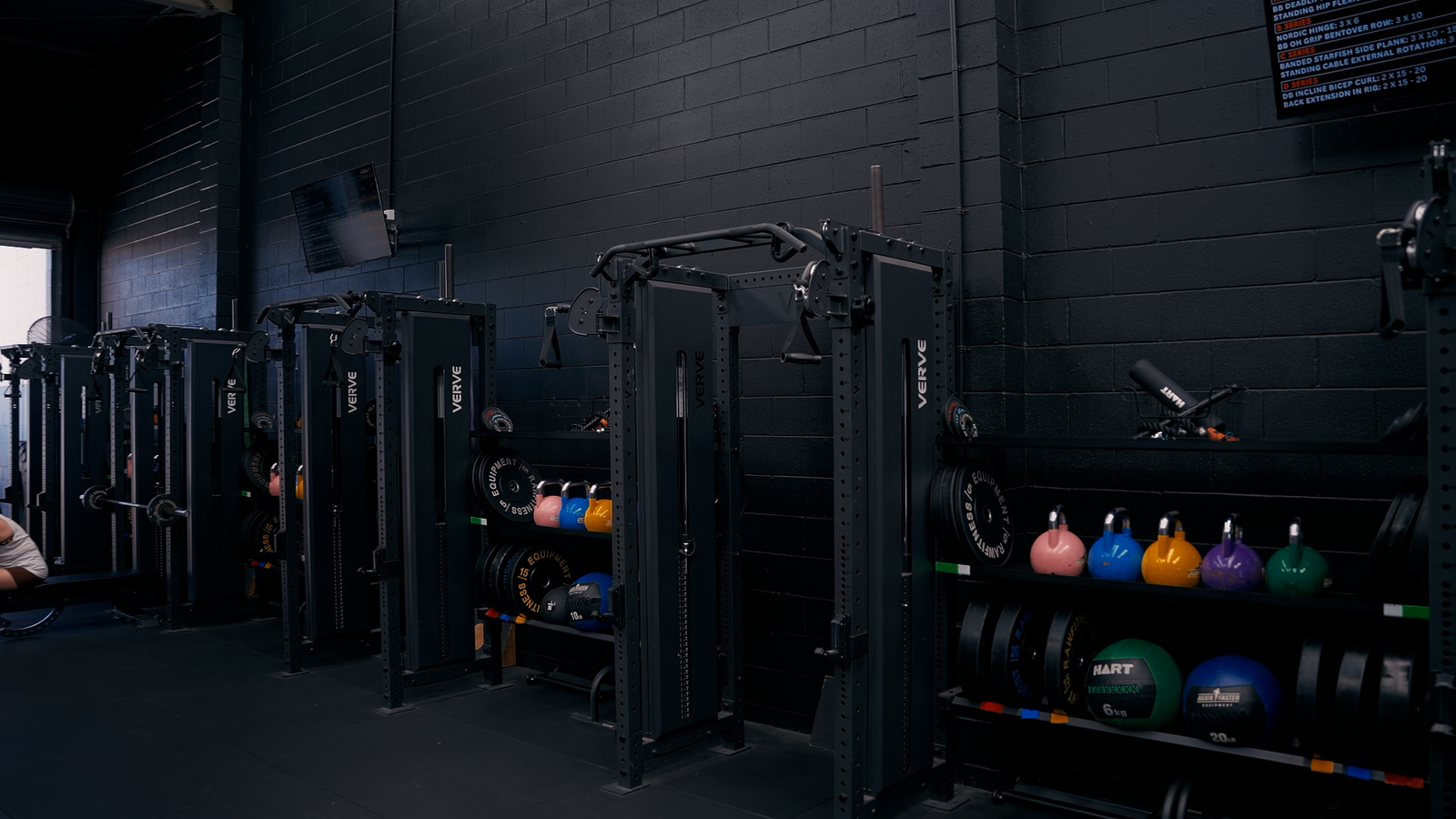
Racks and rigs are usually the piece of equipment under the most sustained load on a camp gym floor. The VERVE Satori Power Rack and a VERVE Panther Sled for conditioning work are both built to commercial specification and are common choices for remote sites, alongside EPDM Rubber Gym Flooring that copes with dust and heavy, repeated equipment movement without needing specialist upkeep.
See Your Camp Gym Before You Build It
Send us your floor plan and our design team will come back with 3D renders, an itemised quote and freight quoted as its own line item, so nothing is a surprise once the equipment is on the way.
Request Your Free DesignInstall crews and replacement planning
Getting equipment to a remote site is only half the job; getting it installed and commissioned properly the first time matters more than it does in a metro gym, because a second trip to fix an install issue is expensive and slow. Plan the install date around your site's access and induction requirements, confirm what induction your supplier's install crew needs to complete before they can get on site, and build the install timeline backwards from your site's actual access windows rather than a generic delivery estimate. Large remote or camp-wide projects, factoring site access, freight lead time and internal approval, can take 6 months to 2 years from first contact to commissioned equipment, so start planning well ahead of when you need the gym open.
Replacement planning matters more on remote sites too: work out which equipment categories you would struggle to run the gym without (cardio, the main rack) and plan a replacement or backup order timeline for those specifically, rather than treating every piece of equipment the same. A supplier who itemises freight and keeps stock levels for common remote orders is worth more on a remote site than one who is marginally cheaper on the equipment line alone. If your team is passing through South East Queensland, VERVE's showroom at 4 Dalton St, Upper Coomera QLD is open to inspect equipment in person, or call 1300 1947 48 to talk through freight and install for your site.
It also pays to agree a servicing plan before the gym opens, not after the first breakdown. Ask your supplier what a standard call-out looks like for your site, how long parts typically take once ordered, and whether a technician needs to fly or drive in, since that changes both cost and downtime. A camp gym that goes quiet for six weeks because a single cable snapped is a worse outcome, and a more expensive one in lost goodwill with the workforce, than paying slightly more up front for equipment and a supplier relationship built for remote servicing from day one.

Get Your Remote Site Gym's Free 3D Design
Send your floor plan through and get a full itemised proposal, equipment, freight and install, ready for internal sign-off, designed, delivered and installed on one invoice.
Request Your Free DesignFrequently asked questions
How much does freight cost for a remote mining camp gym?
Freight varies significantly by distance, access and whether the order ships as a container or palletised freight, which is exactly why it should be quoted as its own line item rather than folded into the equipment price. Ask your supplier to itemise freight separately so you can see and compare it.
How big should a mining camp gym be?
As a general guide, a camp of up to around 150 to 200 people typically needs 100 to 150 square metres, while a larger camp or permanent site of 300 or more typically needs 200 to 300 square metres or larger. Size follows how many people train in a given hour, not total headcount, since shifts stagger usage.
What makes gym equipment suitable for a remote or mining site?
Commercial-grade construction rated for continuous, high-frequency use, simple mechanisms over equipment with proprietary parts that are hard to source on site, dust and climate-tolerant finishes where relevant, and durable, easy-clean flooring.
How do we plan installation on a site with restricted access?
Confirm your site's access windows and induction requirements early and build the install date backwards from those, rather than around a generic delivery estimate. Confirm what induction the install crew needs to complete before they can get on site.
Should we hold spare parts on site?
For remote sites, yes. A basic kit of common wear items, belts and cables, is worth holding on site so a breakdown does not mean weeks of downtime while a part is freighted in.
What hours does a camp gym typically need to operate?
Camp gyms serving rotating shifts are realistically in use from around 4am, when early shifts start or night shift finishes, through to close to midnight. Plan equipment durability, and any staffing or access model, around that extended window rather than a standard 6am to 9pm day.