Every endurance goal runs on the same currency. Kilometres.
A marathon build. An Ironman block. A HYROX season with eight 1km runs between stations. The fitness comes from volume, and volume is where most athletes get stuck. Not because they lack the discipline, but because their legs send the bill before their engine does.
The usual answer is to run less. The better answer is to run the same, somewhere that charges less for it.
Meet Riana
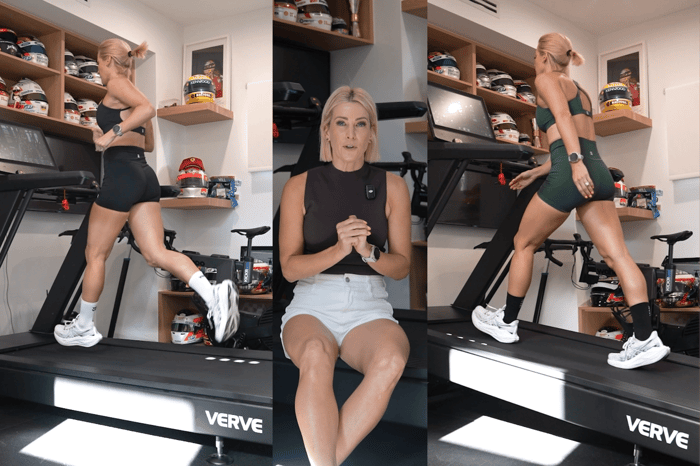
Riana Crehan is a two-time Ironman, and she races the Noosa Triathlon too.
Her first Ironman was Cairns in 2021. It came at the lowest point of her life. COVID had grounded Supercars travel and she had lost her job. Her dad had passed away the year before.
"It was the thing that really got me through one of the most difficult times of my life."
The second one was harder in a different way. She was a new mum, back at work full time, with none of the flexibility she had the first time round.
"I wasn't afforded that much flexibility in my training. I've got a little baby running around. I was back working full time. Having the VERVE treadmill in the house is a godsend. It means that I have so much more flexibility with my training."
That second finish line is the point. The training got done because it lived in the house, not on the other side of a school run, a work day and a dark footpath.
Is treadmill running easier on your joints?
Short answer: the surface is. Here is what the research says, without the hype.
1. The belt gives. Concrete doesn't.
A 2020 study in Sensors (Garcia-Unanue et al.) put treadmill decks through the same mechanical impact test used to certify sports surfaces. The treadmills averaged around 64% shock absorption. That was higher than athletics tracks, which World Athletics requires to sit between 35% and 50%. The test measures everything against a rigid concrete floor, which counts as zero.
So a cushioned deck soaks up a large share of the hit that a footpath hands straight back to you.
2. Your stride doesn't change much. The conditions do.
To be straight with you: a treadmill doesn't rebuild your running mechanics. A 2020 review of cross-over studies in Sports Medicine (Van Hooren et al.) found treadmill and overground running are largely comparable in how people move.
That's good news. It means the kilometres you bank on the belt are real running, not a watered-down version. What changes is everything around the stride. No camber tilting one ankle for 40 minutes. No kerbs, potholes or tree roots. No blind corners at 5am. Every step lands on the same flat, predictable surface.
3. Climb instead of pound.
This is the big one for endurance athletes. Research from the University of Colorado (Gottschall and Kram, Journal of Biomechanics, 2005) found that impact forces drop when you run uphill. At steep grades, the impact peak sometimes disappeared altogether. Running downhill does the opposite and drives impact up.
Outside, every hill you climb has a descent attached. On a treadmill you get the climb without the drop. You can build heart rate and leg strength at a slower pace, with softer landings, and skip the downhill pounding completely.
For HYROX athletes and triathletes, steep incline walking is also a straight line to the kind of strength that holds up when your legs are already cooked.
How to shift your volume indoors
The goal isn't to never run outside again. Race day is on bitumen, and your body needs to know it. The goal is to move the kilometres that don't need to be outside.
Move your easy runs. Recovery runs and easy aerobic kilometres make up most of a good endurance week. They gain nothing from the road except wear. Put them on the belt.
Use incline for strength endurance. Swap one flat session a week for a steep walk or slow climb. Start at 8% to 10% and build toward 15% and beyond.
Own your intervals. A treadmill holds the pace you set. No drifting on the fourth rep, no traffic lights mid-effort.
Keep your specific work outside. Long runs, race-pace sessions and brick runs for triathletes should keep some road time, so your feet, ankles and pacing stay race-ready.
Set 1% for easy running. A long-standing study (Jones and Doust, 1996) found 1% incline makes treadmill running feel closer to the effort of running outside, with no wind to push against.
Riana's go-to session
"A typical session on the Kuro, it might be like a 10 to 20 minute warm-up, just very, very easy jogging and then do some efforts. You can do so many different options of a type of tempo run. The options really are endless."
And on the days the tank is low:
"Not every day has to be absolute, you know, 110%, the hardest training session you've ever done. Sometimes just walking on an incline treadmill to music is enough."
A sample week
Adjust it to your coach's plan and your race. This isn't a prescription.
| Day | Session | Where |
|---|---|---|
| Mon | 30 to 40 min easy run, 1% incline | Treadmill |
| Tue | Warm-up, then 5 x 4 min tempo, 2 min easy | Treadmill |
| Wed | 40 min incline walk, 10% to 15% | Treadmill |
| Thu | Easy run or rest | Treadmill |
| Fri | Strength, or swim/bike for triathletes | Gym or pool |
| Sat | Long run or brick session | Road |
| Sun | Run club or race-pace work | Road |
Five of the seven running sessions come off the road. Your total volume doesn't move.
What an endurance athlete needs from a treadmill
Most treadmills are built for a 20 minute jog. Endurance training asks more.
A motor built for long sessions. An AC motor holds speed under load and runs cooler over 60 to 90 minutes. The Kuro runs a 3.0kW AC motor.
A deck long enough for a full stride. At tempo pace your stride gets long. A 1600mm running surface lets you open up without shortening your gait to fit the machine.
Real incline. 15% or more is where incline starts working as strength training. The Kuro climbs to 20%.
Top speed for intervals. The Kuro runs to 24 km/h, well past any interval most athletes will ever need.
Something to look at. Long sessions indoors are a head game. The Kuro Touchscreen carries scenic trails, programs and heart rate zones. Riana uses them to tune out.
Which VERVE treadmill fits your training
VERVE Kuro Commercial Treadmill. The endurance workhorse. 3.0kW AC motor, 1 to 24 km/h, 0% to 20% incline, 600 x 1600mm cushioned deck.
VERVE Kuro with Touchscreen. The same machine as Riana's, with a 21.5 inch touchscreen for trails, programs and heart rate zones.
VERVE Velocity Full Commercial Treadmill with Touch Screen. Full commercial build for high-volume use.
VERVE Curved Treadmill. Self-powered, no motor. You set the pace with your stride. Made for HYROX-style sprints and hard intervals. A 2016 study in Gait & Posture (Montgomery et al.) found tibial impacts were lower on non-motorised treadmills than on motorised treadmills or overground.
|
VERVE Kuro Commercial Treadmill 
$7,499 A commercial treadmill for high traffic facilities and home gyms. A 3.0kW AC motor drives 1 to 24 km/h with 0 to 20% incline on a 600mm by 1600mm running surface. The 21.5 inch LED console carries preset and self… read more VERVE Velocity Full Commercial Treadmill with Touch Screen 
$7,999
FULL COMMERCIAL TREADMILL (TOUCH SCREEN) The VERVE Velocity Full Commercial Treadmill was designed to ensure peace of mind for gym owners and provide a great running experience for gym members. With our high-powered 4CHP Perpetua Motor, you can be confident… read more |
VERVE Kuro Commercial Treadmill - with Touchscreen 
$9,499 A commercial treadmill for busy floors and serious home gyms. A 3.0kW AC motor holds speed under load across 1 to 24 km/h and 0 to 20% incline, on a cushioned 600mm by 1600mm running surface. The 21.5 inch touchscreen… read more VERVE Curved Treadmill 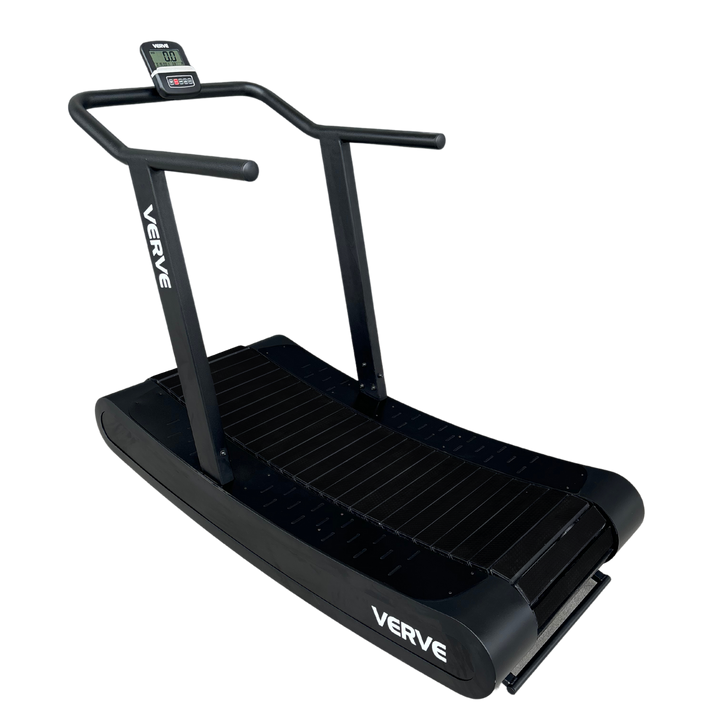
$4,299 A motorless curved treadmill for home gyms and facilities that run all day. The curved belt is driven by your stride, so it speeds up when you push and slows when you ease off, with no motor and no buttons.… read more |