You're not training to be a bodybuilder. So stop training like one.
Most runners either skip the gym entirely or go too hard and wreck their legs for the next three days. Neither approach makes you faster. There's a middle ground, and it takes 30 minutes.
We asked a running coach a simple question: What should a gym session actually look like if you're trying to improve as a runner?
His answer was refreshingly direct.
The philosophy: support the run, don't sabotage it.
The coach's number one rule? Your gym session should never jeopardise your running week.
That means no crawling out of the gym. No leg sessions so heavy you can't back up your next run. The whole point of strength work for runners is to build running economy and control - not to chase PRs on the squat rack.
Short. Sharp. Purposeful. Get in, do the work, get out.
The 30-minute program.
Do this 1–2x per week alongside your regular running schedule.
Warm-up (5 minutes)
| Exercise | Duration |
|---|---|
| Light jog or bike | 2 min |
| Leg swings (front-to-back + lateral) | 10 each side |
| Bodyweight squats | 10 reps |
| Single-leg glute bridges | 8 each side |
The goal here isn't to break a sweat - it's to wake up the hips, glutes, and ankles before you load them.
Block A - Strength (15 minutes)
These are your priority movements. Take them seriously, but don't go to failure. You should finish each set feeling like you had 2–3 reps left in the tank.
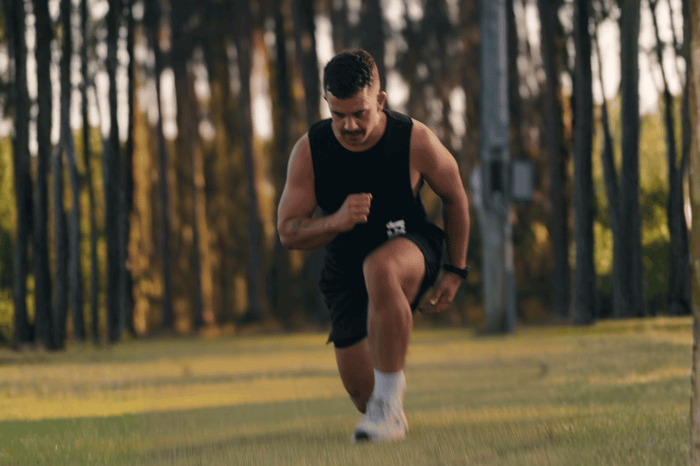
A1. Bulgarian split squats
● 3 sets x 8 reps each leg
● Tempo: 3 seconds down, 1 second pause, 1 second up
● Rest: 60 seconds between legs
This is the single best lower-body exercise for runners. It builds single-leg strength, challenges hip stability, and directly transfers to your stride mechanics. The slow tempo builds control without requiring heavy loads.
A2. Standing calf raises
● 3 sets x 12–15 reps
● Tempo: 2 seconds up, 3 seconds down (the slow lower is where the magic happens)
● Rest: 45 seconds
Your calves absorb 6–8x your bodyweight with every stride. Weak calves mean shin splints, achilles issues, and slower turnover. The coach specifically called these out - they're not optional.
Block B - Control and stability (8 minutes)
Superset these two exercises back-to-back with minimal rest. These build the lateral hip stability and trunk control that keeps you efficient when fatigue sets in.
B1. Single-leg Romanian deadlift
● 3 sets x 8 each side
● Use a dumbbell or kettlebell in the opposite hand
This trains the posterior chain (hamstrings, glutes) through a single-leg pattern that mirrors the running stride. It also bulletproofs your hamstrings against the repetitive stress of longer runs.
B2. Side plank with hip dip
● 3 sets x 10 each side
Hip drop during running is the number one cause of knee pain in runners. This fixes it at the source.
Cooldown (2 minutes)
| Exercise | Duration |
|---|---|
| Standing quad stretch | 30 sec each side |
| Calf stretch (wall lean) | 30 sec each side |
Keep it brief. You should walk out of this session feeling better than when you walked in.
The rules.
1. Don't go to failure. Leave reps in the tank. You need your legs tomorrow.
2. Prioritise control over load. Slow tempos, full range of motion. This isn't CrossFit.
3. Keep it short. 30 minutes is enough. More than that and you're probably doing too much.
4. Stay consistent. One quality session per week beats three sporadic ones every month.
5. Listen to your legs. If you're backing up a hard run the next day, drop the weight or cut the volume.
The right setup makes the difference.
Bulgarian split squats need a stable bench. Calf raises need a platform. Single-leg RDLs need quality dumbbells or kettlebells that feel right in your hand.
If your equipment wobbles, slides, or doesn't feel solid, you're fighting the gear instead of focusing on the movement. That's wasted effort.
VERVE equipment is built for exactly this kind of training. Commercial-grade construction that stays locked in so you can focus on the work that actually matters.