If your lifts have stalled, the problem isn't effort. It's the principle you're not applying.
Progressive overload is the reason some lifters add 50kg to their bench in a year and others add nothing. Get it right and you keep moving for decades. Get it wrong and you plateau in six months.
This is what it is, why it matters, and the one rule every serious lifter follows.
What is progressive overload?
Progressive overload is the slow, deliberate increase in demand you place on your body session after session.
More weight on the bar. More reps. More sets. More tempo under load. Pick one. Push it slightly past last time. Recover. Repeat.
It's the only reason your muscles, tendons, bones and nervous system have to adapt. Take the stimulus away and adaptation stops with it.
Why it matters more than your programme
You can run any sensible programme. 5/3/1, Starting Strength, GZCL, push pull legs, upper lower, full body. They all work.
The reason they work is because they apply progressive overload.
Take overload out and the programme is just exercise. You'll maintain. You won't grow. This is why two lifters can train for two years and end up in completely different places.
The one who tracked loads and pushed them up got stronger. The one who lifted "whatever felt right" did not.
Why your lifts have stalled
The plateau is almost always a maths problem.
When you're new, 2.5kg jumps work. Your nervous system is learning, your tissues are adapting, you can add 5kg to the bar (2.5kg per side) week after week and keep moving.
That stops working faster than most lifters expect.
Add 5kg to a 100kg bench and you've just asked your body for a 5% jump in one session. At 60kg, that's an 8% jump. Past the beginner phase, your body can't absorb increases that big that often.
You miss the rep. You miss it again. You stall.
The fix: smaller jumps, more often
The fix isn't a new programme. It's smaller plates.
Fractional plates. 1.25kg. 1kg. 0.5kg. Drop the jump from 5kg to 1kg, or even 500g, and progress doesn't stop. It compresses.
1kg per week on your bench is real, sustained progress. Nobody adds that kind of weight by trying to jump 5kg at a time.
The rule every serious lifter follows
Here's the part most people skip.
Never end a session on a failed lift.
When you fail a rep at the top of a working set, your brain logs that weight as "too heavy." Next time you load the bar, you carry the failure with you. Bar speed slows. Setup tightens up. Doubt creeps in before the unrack.
The fix is built into every strength tradition that's lasted more than a decade. Strip the bar down and hit a clean rep. Always. Doesn't matter how light. The session must end on a successful lift.
This is where fractional plates earn their keep twice.
How to apply it in your next session
Say you hit 102.5kg for 4 reps on bench, going for 5. The fifth rep stalls halfway. You re-rack. Most lifters call it a day there.
Don't.
Pull 1.25kg off each side. Lift 100kg for a clean single. Re-rack. Done.
You've just programmed your nervous system to associate the bar coming off the rack with a successful lift. Next session, that 102.5kg feels different. The setup is sharper. Your body remembers the win, not the miss.
Strength coaches have taught this for decades. Powerlifters use it to manage confidence going into meets. It works because your brain doesn't separate physical capacity from belief about capacity.
The last rep of the session is the one that stays with you.
Why fractional plates make this possible
You can't end a session on a successful lift if your smallest jump down is 2.5kg per side.
A 5kg drop on a near-max bench is the difference between a clean lift and another grind. Fractional plates let you taper. Strip 0.5kg, 1kg, 1.5kg per side. Find the exact weight you can move clean. Hit it. Walk away.
This is why every serious training facility stocks them.
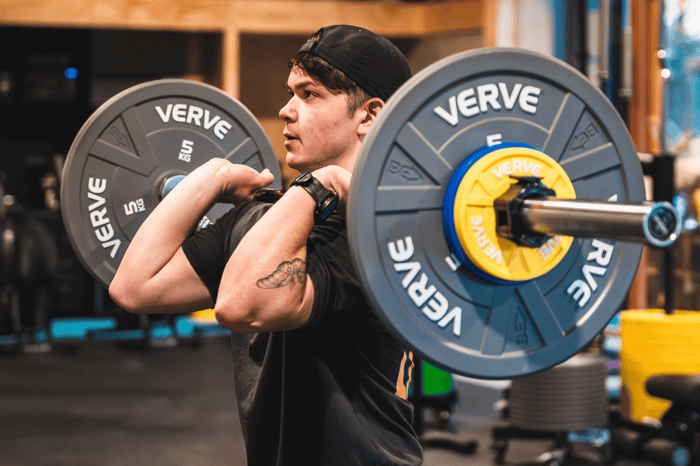
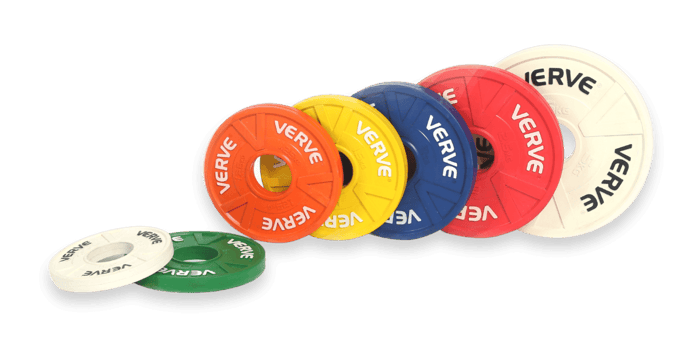
VERVE Colour Change Plates
Calibrated. Colour-coded. Available in 0.25kg, 0.5kg, and 1.25kg increments.
Small enough to keep you progressing for years past where 2.5kg plates leave you stuck. Precise enough to end every session on a clean rep.
VERVE Colour Change Plates

$45
VERVE Rubber Change Plates The VERVE rubber change plates offer the ability to macro load a bar to any specific weight increment as low as 0.5kg. These weights are perfect for breaking through PB plateaus by edging on barely… read more

The takeaway
- 1. Strength is built by progressive overload. Programme choice is secondary.
- 2. Once beginner gains end, 2.5kg jumps are too big. Switch to fractional plates and keep moving.
- 3. Never end a session on a failed lift. Strip the bar, hit a clean rep, walk out with a win on the books.
Train smarter. Add less. Add more often.
FAQs
What is progressive overload in simple terms?
Doing slightly more this session than you did last session. More weight, more reps, or more sets. That's it.
How fast should I add weight to the bar?
Beginners can add 2.5kg per side weekly for a while. Past that, 0.5kg to 1kg per side per session is realistic on most lifts. Smaller, more often beats bigger, less often.
Are fractional plates worth it?
If you've been stuck on the same lifts for more than a month, yes. They turn a stalled progression into a steady one.
Why shouldn't I end a session on a failed rep?
Because your nervous system remembers the last rep. Ending on a miss programmes hesitation into your next setup. Ending on a clean lift programmes confidence.